Resilient First Responder Families

About this course
And this is for the ones who already know that resilience and prevention start from day one on the job and during training.
It is for those who watched mental health be treated like an afterthought and mental illness be shamed; who thought it would never happen to them, enduring the financial losses and the loss of family and friends.
This is for the hero who ended up on the other end of a call; who cannot see themselves without being dialed in; who disassociates their emotional pain by believing it is physical; who feels they belong nowhere, trying to soothe with overtime shifts and second jobs.
It's for the one hiding in their home at night, afraid of crowds, or unable to connect in relationships because they do not feel safe sharing their sanctuary. For those who feel the weight of golden handcuffs, or who can no longer connect with their family. For those who are finally allowing themselves to believe they are deserving of rest from their badge or uniform.
For those whose PTSD (Post Traumatic Stress Disorder) took their families, their identity, and left them with shame and thoughts of ending their life—knowing it all started with driving fast and dark humour connecting the team, but realizing the team is not one of true connection.
You are not alone. There is another way.
And finally, this is for all the families that stay to support: this is your map to a brighter future with your First Responder.
This course is for professionals who serve in roles where exposure to human suffering, violence, and acute danger is routine, systemic, and cumulative. The common denominator for every person in this book is the need for a trauma recovery model that addresses the issue at the biological and nervous system level, bypassing the cognitive defenses that their jobs require. This course is a map for them and for their families.
Course curriculum
1.
Course Contents
64 lessons
- 1
Welcome Aboard!
- 2
Lesson 1.2: Ritual in Traditional Protective Services: Examining inherent, often unconscious rituals in modern departments.
- 3

Lesson 1.3: The Power of Predictability: How rituals provide order, safety, and a psychological container for chaos.
- 4
Lesson 1.4: The Loss of Transition: How modern speed and efficiency have eroded essential post-event transition rituals.
- 5

Chapter 2: The Double-Edged Sword: Talk Therapy and the Pathologizing of Stress
- 6

2.2 Mental Illness vs. Mental Health: Distinguishing between genuine mental illness and the natural, physiological reaction to trauma and stress (i.e., treating normal reactions as pathology).
- 7

2.3 The "Trauma Narrative" Trap: The danger of forcing a linear story when trauma is stored non-verbally in the body.
- 8

2.4 Why High-Stress Professionals Resist Talk: The cultural, professional, and physiological reasons why sitting and talking can feel counterproductive or unsafe.
- 9

2.5 Parts Chapter 2 continued
- 10
2.6 Chapter 2 Continued
- 11

3.1 Defining the Kindling Effect: Explaining the neurobiological and psychological process where repeated exposure to low-level stress lowers the threshold for high-level traumatic reactions.
- 12

3.2 The Invisible Load: How kindling manifests in daily life (sleep disturbance, hypervigilance, irritability, relationship strain).
- 13

3.3 The Neurological Mechanism: Simplified explanation of the brain (amygdala, hippocampus) and nervous system dysregulation under chronic kindling.
- 14
3.4 Breaking the Cycle: Initial steps toward identifying and disrupting the kindling process.
- 15

Chapter 4: The Ancestral Blueprint: Heritage and Your Trauma Threshold
- 16

4.2 Cultural Coping: Exploring how specific heritage or community practices (or lack thereof) condition responses to stress.
- 17

4.3 The Role of Family Narratives: How early life environment and family history shape the perception of safety and risk.
- 18

4.4 Personalized Resilience: Understanding your unique inherited threshold is the first step toward managing it.
- 19
Chapter 5: The Body on Fire: Hormones, Health and the Kindling Cascade
- 20

5.2 PTSD: From Psychological Disorder to Brain Injury
- 21

5.3 Somatic Manifestations of Trauma: The Emotional Pain Chart
- 22

5.4 Endocrine Cascade: Cortisol and Testosterone Suppression
- 23

5.5 The Trauma Brain: Somatic Diversion and the Primal Survival Economy
- 24
5.6 Relational Trauma, Isolation, and the Inner Child
- 25

5.7 Relational Trauma, Isolation, and the Inner Child
- 26

5.8 Recap On Why We Created Code 200
- 27
5.9 Sleep and Mindset shift
- 28

5.10 Melatonin and sleep
- 29

5.11 Environmental Reset: Light and Temperature
- 30

5.12 Electrical and Nutritional Grounding
- 31

Chapter 6: The Architectures of Belonging: Ritual and Collective Healing
- 32

6.1 Transition: Rites of Passage as Systems Check
- 33

6.1.1 Meaning and Movement: Restoring the Collective Body
- 34
6.2 The Music of Regulation: Sound, The Vagal Nerve, and Ancestral
- 35

6.3 The Container
- 36

6.3.2 Container continued
- 37

6.4 Designing the Daily Wellness Routine: Replacing the Function of Ritual
- 38

6.5 NSDR and 4 Elements
- 39

6.6 The Flash Technique
- 40

6.6.1 Flash Continued
- 41

6.7 Affirmations and the Emotional Bank Account
- 42

6.8 NLP
- 43

6.9 Part 1 Future Directions: Integration and Collective Trauma
- 44

6.9 Part 2 EFT Tapping
- 45
6.9 Part 3 (missing)
- 46

6.9 Part 4 Parts discussion
- 47

6.9 Part 5 Appreciation
- 48

6.9 Part 6 What Do You Need
- 49

Chapter 7: Mindfulness for the Traumatized System: A Critical Analysis
- 50
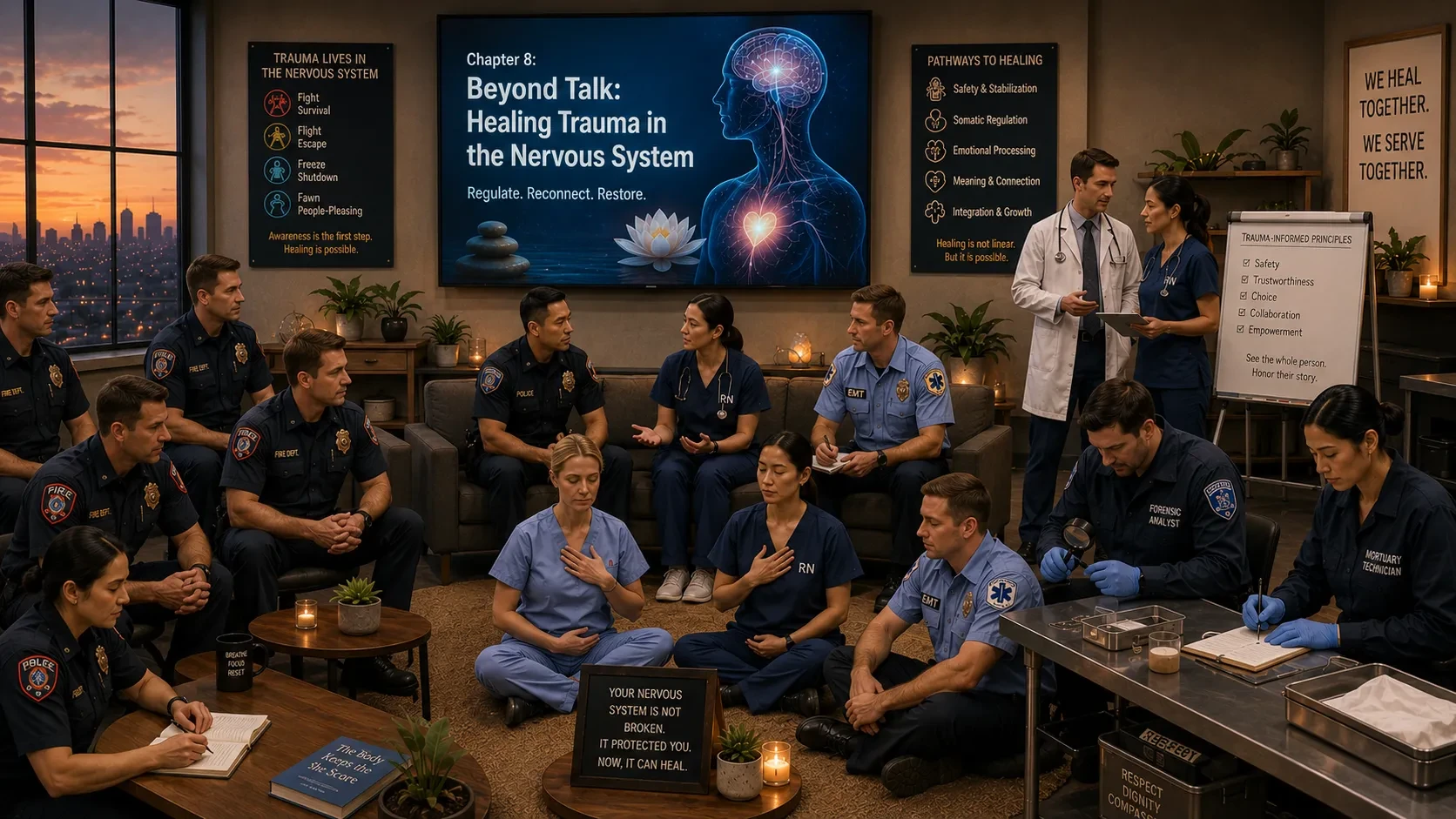
Chapter 8: Beyond Talk: Healing Trauma in the Nervous System
- 51

Chapter 9: The Compassion Cost: Managing Secondary Trauma
- 52

9.2 Refuge
- 53

Chapter 10 Unpacking the Load Daily
- 54

Chapter 10 unpacking the load part 2
- 55

Chapter 11: The Home Front: Family as the Final Anchor Against Moral Injury
- 56

Chapter 11.2 The Suicide Crisis: Loss of Future, Not Just Depression
- 57
11.3 Moral Injury at Home: The Perfect Hero vs. The Damaged Partner
- 58

11.4 Re-integrating the "Warrior": Simple Strategies for Family Repair
- 59
Chapter 12: Systemic Shift: Creating Healthier Departments
- 60
Chapter 12 Part 2 of 1
- 61
Chapter 12.2: Post-Incident Procedures: From Debriefing to Systematic Discharge
- 62
Chapter 12.3: Wellness Integration
- 63
Chapter 12.4: Normalizing Help-Seeking
- 64

Chapter 13: The Ever-Evolving Toolbox: Your Personalized Action Plan

Resilient First Responder Families
This course is dedicated to all the first responders who thought they were handling things well by numbing; who bought into the "lions not sheep" mentality and then had everything stripped from them piece by piece. And this is for the ones who already know that resilience and prevention start from day one on the job and during training. It is for those who watched mental health be treated like an afterthought and mental illness be shamed; who thought it would never happen to them, enduring the financial losses and the loss of family and friends. This is for the hero who ended up on the other end of a call; who cannot see themselves without being dialed in; who disassociates their emotional pain by believing it is physical; who feels they belong nowhere, trying to soothe with overtime shifts and second jobs. It's for the one hiding in their home at night, afraid of crowds, or unable to connect in relationships because they do not feel safe sharing their sanctuary. For those who feel the weight of golden handcuffs, or who can no longer connect with their family. For those who are finally allowing themselves to believe they are deserving of rest from their badge or uniform. For those whose PTSD (Post Traumatic Stress Disorder) took their families, their identity, and left them with shame and thoughts of ending their life—knowing it all started with driving fast and dark humour connecting the team, but realizing the team is not one of true connection. You are not alone. There is another way. And finally, this is for all the families that stay to support: this is your map to a brighter future with your First Responder. This course is for professionals who serve in roles where exposure to human suffering, violence, and acute danger is routine, systemic, and cumulative. The common denominator for every person in this book is the need for a trauma recovery model that addresses the issue at the biological and nervous system level, bypassing the cognitive defenses that their jobs require. This course is a map for them and for their families.
US$ 497
14 members