Back

posted in

AI Mastery

Why So Many AI Users Suddenly Feel Like Their Tokens Are Disappearing
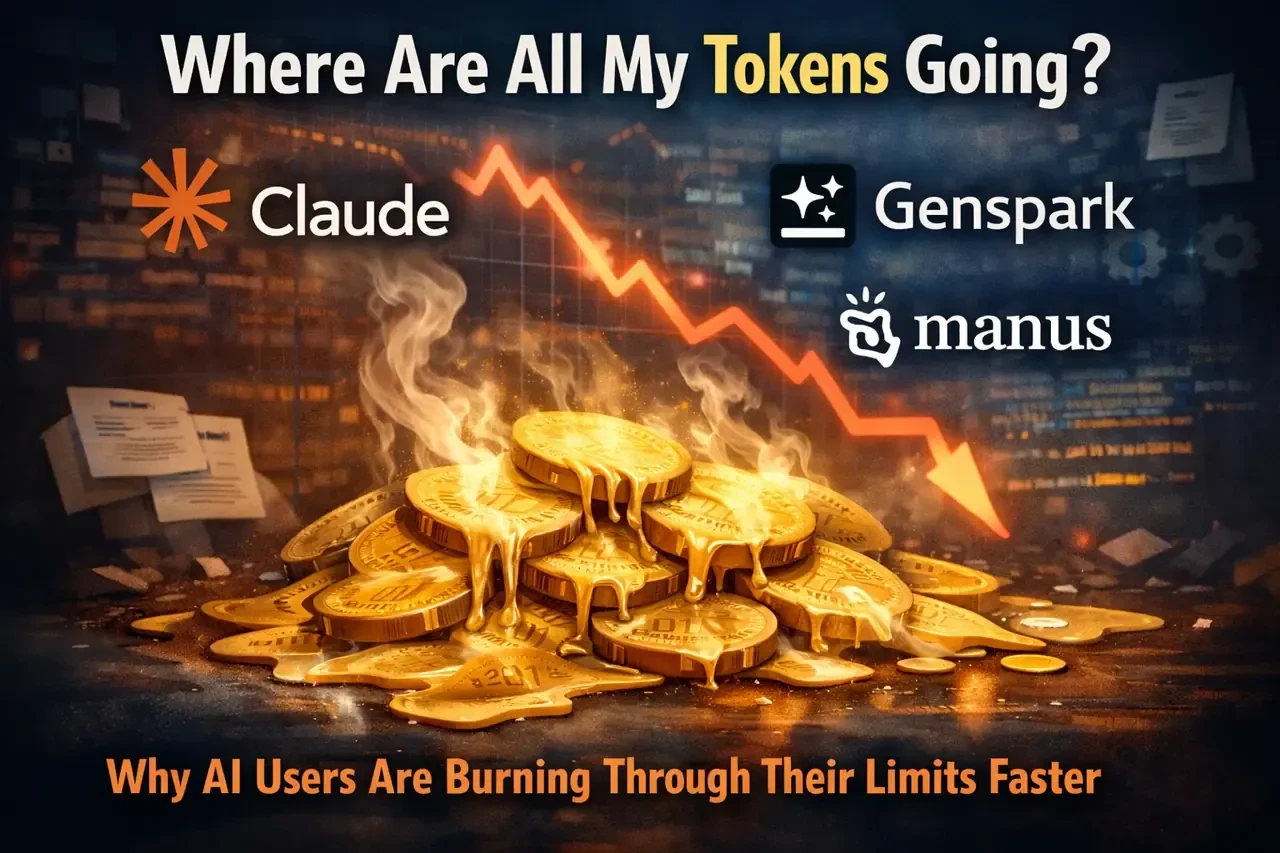
Across tools like Claude, Manus, Genspark, and others, more and more users are saying the same thing: they are doing what feels like the same kind of work they were doing before, yet their monthly usage is burning up dramatically faster. Tasks that once seemed sustainable for weeks are now draining a full allotment in days.

Even users who upgraded to higher-cost plans are reporting that the extra headroom disappears almost immediately.

That frustration is not just in people’s heads.

At the moment, the clearest public confirmation comes from Claude. Anthropic has acknowledged that some users were hitting usage limits far faster than expected, which is important because it confirms that at least part of the recent surge in complaints was rooted in a real platform-side issue, not just perception. On top of that, Anthropic’s own documentation explains that usage is affected by things like message length, attachment size, and conversation length, and that Claude and Claude Code share the same usage pool on paid plans. In plain English, that means a task that looks “the same” from the user’s perspective may actually be far more expensive than it used to be.

And Claude is likely just the most visible example, not the only one.

With Manus, the company openly states that it runs on a credit-based system and that credit usage depends on the complexity and resources required for each task. It also says it cannot reliably tell users in advance exactly how many credits a given task will consume. That unpredictability is a big part of why users feel blindsided.

When a system cannot tell you ahead of time what a task will cost, it becomes very easy to feel like your credits are vanishing for no obvious reason. Manus also has a published refund policy for credits lost due to bugs or platform malfunctions, which strongly suggests that unexpected burn from failed or broken workflows is a known enough issue to require formal handling.

Genspark presents a similar dynamic, though in a slightly different way. Its documentation makes clear that some forms of use are effectively unlimited only in specific areas, while credit consumption varies depending on the task type, agent, and features used. So a user may think, “I’m doing the same thing I was doing before,” while the platform is actually routing that request through a more expensive agent workflow, or invoking extra tool use behind the scenes. Public user discussions around Genspark reflect that same experience, with complaints that credits now disappear much faster during advanced workflows.

So what is actually going on?

The simplest answer is this: these tools are doing more than they used to, and that extra work costs money.

What looks like a single request is often no longer just a single request. Behind the scenes, agent-style systems may now be breaking a task into multiple steps: reading files, searching the web, reasoning across longer context windows, retrying failed actions, calling multiple models, generating structured outputs, and orchestrating tools. The user sees one prompt. The platform may be doing the equivalent of ten or twenty operations.

That matters.

A year ago, “write this,” “summarize this,” or “help me research this” might have been a fairly straightforward language-model interaction. Now, the same broad request may trigger a much heavier backend process. If the tool has become more capable, more autonomous, and more tool-connected, then the cost of the same apparent task can rise sharply even if the wording of the prompt does not.

There is also a context problem.

Anthropic’s documentation specifically notes that usage is affected by the length of the conversation and the size of the content being processed. That means a prompt submitted inside a long-running thread can cost much more than the same prompt would cost in a fresh conversation. The user experiences that as inconsistency. The platform experiences it as simple math.

Then there is the issue of marketing language versus billing reality.

Many users understandably interpret flat-fee AI subscriptions as meaning they can use the product roughly the way they used it last month, only faster and better. But that assumption is breaking down. Some products advertise “unlimited” access in ways that apply only to certain surfaces or certain kinds of use. Once a user moves into heavier-duty agents, advanced generation, file-heavy tasks, or multi-step workflows, the billing mechanics can change quickly. Genspark’s own materials reflect that distinction.

Finally, there is likely a broader capacity story underneath all of this.

Anthropic recently restricted some third-party usage patterns and explained that they were placing an outsized strain on systems. That is a revealing phrase. It suggests that these companies are facing a hard reality: as users demand more powerful agentic behavior, the old subscription assumptions start to crack. A flat monthly price is much easier to sustain when most users are chatting lightly than when power users are effectively running a mini workforce through the system every day.

Put all of that together, and the pattern starts to make sense.

Users are not imagining it. The reports are real. In Claude’s case, the issue has been publicly acknowledged. In tools like Manus and Genspark, the billing structures and user complaints point in the same direction. What looks like a simple prompt on the surface may now trigger far more work behind the scenes than it did before.

That helps explain why so many people feel like their tokens, credits, or usage limits are disappearing faster than ever.

Now I am curious about your experience.

Have you noticed your usage burning up much faster lately, even when you feel like you are doing the same kinds of tasks as before?

Have you changed the way you use these tools, or do you believe the platforms themselves have changed the rules of the game?

I would love to hear what you are seeing.

Why So Many AI Users Suddenly Feel Like Their Tokens Are Disappearing